
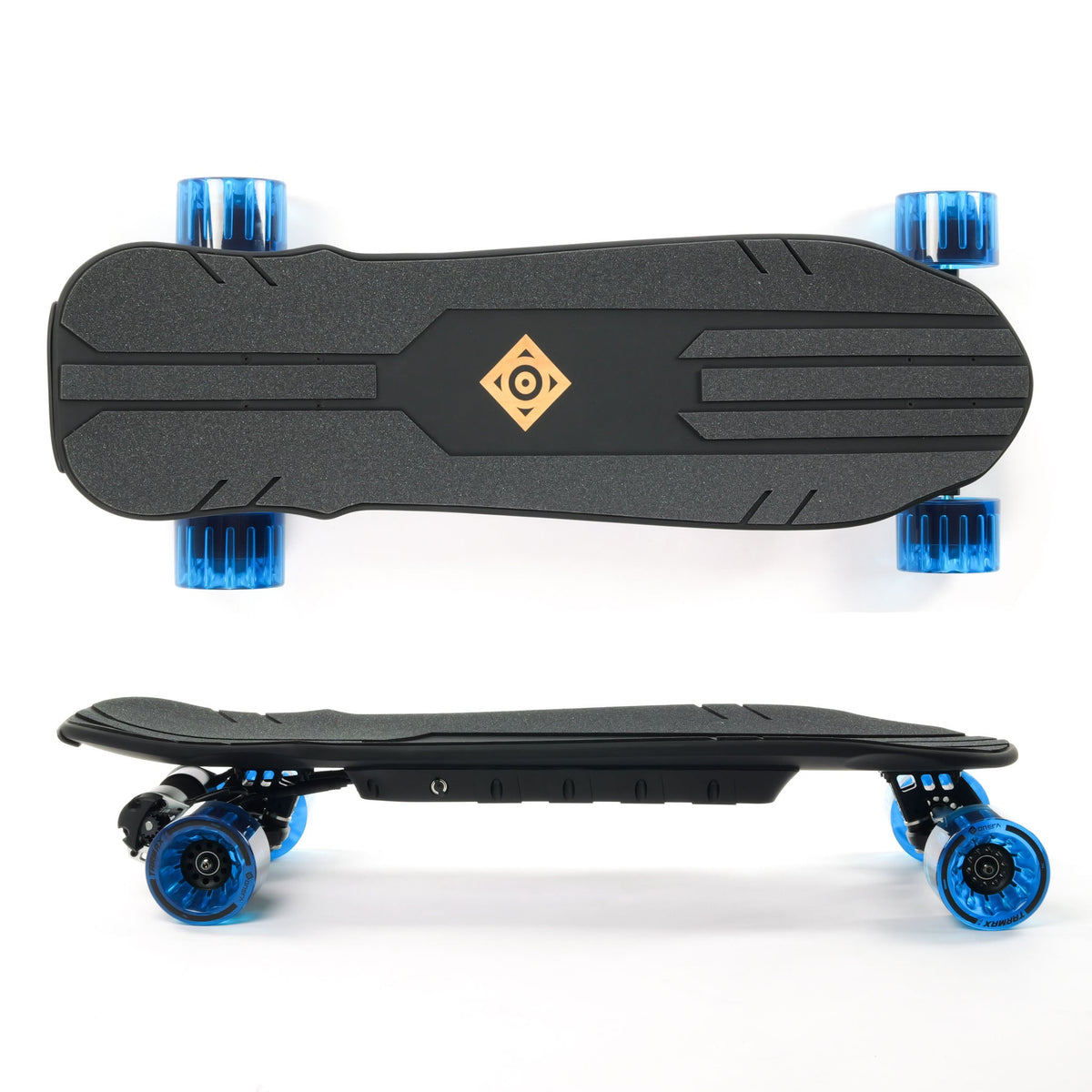
What is the most portable electric vehicle you can actually ride to work, up a mountain road or across town? We think the answer is simple: a portable electric skateboard. It is the only electric vehicle that you carry like a bag, that slides into the trunk (boot) next to your groceries, and that uses a fraction of the energy of a car for the same kilometre.
That is a bold claim from a company that builds electric skateboards, so in this article we back it up with numbers: the real weights, deck sizes and battery capacities from our own product pages, typical figures for bikes, e-bikes, e-scooters and electric unicycles (EUCs) from their makers, and the airline rules that decide whether you can fly with a board.
The short version:
- Efficiency: an ONSRA board uses roughly 6 to 19 Wh per km. The average electric car in the EV Database uses 191 Wh/km. The main reason is weight.
- Size and weight: our boards weigh between 6.5 and 20 kg. That is lighter than a typical e-bike, e-scooter or EUC, and far smaller than any bicycle.
- In the car: two or three boards fit in a normal car, and the off-road boards do not take much more space.
- Smallest boards: the ZENO is the smallest board you can order today. The upcoming Sino, with push assist, will be the smallest board in our lineup.
- Flying: what counts is the battery's Wh rating. Only a battery of 100 Wh or less can travel without airline approval under IATA guidance, and some airlines ban personal electric vehicles completely.

Why is an electric skateboard so efficient?
A car is a heavy machine built to move a few people. A board is a light machine built to move one. That difference in weight explains most of the energy gap.
According to the ICCT European Vehicle Market Statistics, the average new passenger car registered in the EU in 2024 weighed 1,554 kg. Our heaviest board, the VELAR 2.0 S, weighs 20 kg. The Challenger 2.0 Street weighs 9.9 kg. Even with a 75 kg rider on top, a car carrying that same rider moves around 19 times more mass than a Challenger with its rider.
Less mass means less energy to accelerate and less rolling resistance, and you can see it in the numbers. We divided the battery capacity on each ONSRA product page by the range listed on the same page:
| Board | Battery | Listed range | ≈ Wh per km |
|---|---|---|---|
| ZENO (99 Wh battery) | 99 Wh | 17.6 km ECO / 13.2 km BRUTALE | 5.6–7.5 |
| Challenger 2.0 Street | 444 Wh | 38 km, up to 43 km | 10.3–11.7 |
| Challenger 2.0 AT | 444 Wh | 24 km on 155 mm AT tires | 18.5 |
| BLACK Carve 4 | 777 Wh | 50 km ECO / 40 km BRUTALE | 15.5–19.4 |
| VELAR 2.0 / 2.0 S | 1036 Wh | 60 km, up to 70 km | 14.8–17.3 |
| Average electric car (EV Database) | – | – | 191 |
That means an electric skateboard uses roughly 10 to 34 times less energy per kilometre than the average electric car.
Two honest notes. First, this is a rough comparison: we use the nominal battery capacity, and your range depends on your weight, speed, hills and temperature. The BLACK Carve 4 and ZENO ranges on our product pages are rated with a 75 kg rider. If you want the full picture, read our electric skateboard range test. Second, a car carries passengers and luggage, and a board does not. But for the many trips where you drive alone, a board does the same job with a tiny fraction of the energy.
How much does an electric skateboard weigh compared to a bike, e-scooter or EUC?
This is where "portable" stops being a marketing word. Here are the weights and sizes from the product pages, next to typical figures from other makers:
| Vehicle | Example | Weight | Size |
|---|---|---|---|
| Electric skateboard | ONSRA ZENO | 6.5 kg (99 Wh battery) | 71.5 cm long, 24.5 cm deck width, 13.2 cm high |
| Electric skateboard | ONSRA Challenger 2.0 Street / AT | 9.9 / 10.1 kg | deck 90 × 27 cm, wheelbase 73 cm |
| Electric skateboard | ONSRA BLACK Carve 4 Street / AT | 15.5 / 15.8 kg | deck 102 × 27.5 cm, wheelbase 100 cm |
| Electric skateboard | ONSRA VELAR 2.0 / 2.0 S | 18.4 / 20 kg | deck 92.3 × 28.3 cm, wheelbase 96.5 cm |
| Bicycle | Fixed-gear bike (Dimensions.com) | about 11.8 kg | 167.6–171.1 cm long, 50.8 cm wide |
| E-bike | Gazelle e-bikes (Gazelle) | 20–26 kg without battery, plus 2.5–4 kg battery | bicycle-sized |
| E-scooter | Segway Ninebot Max G2 (Segway) | 24.25 kg | folded 121 × 57 × 60.5 cm |
| E-scooter | Xiaomi Electric Scooter 4 Pro 2nd Gen (Xiaomi) | 19 kg | – |
| Electric unicycle (EUC) | InMotion V12 (InMotion) | about 29 kg | 49.7 × 19 × 60.7 cm |
ONSRA lists deck size and wheelbase for most boards. The overall length including wheels is only listed for the ZENO, so we do not quote an overall length for the other boards.
What the table shows:
- Against a bike: even our longest deck (BLACK Carve 4, 102 cm) is much shorter than a bicycle, which is around 1.7 m long and has handlebars and pedals sticking out. A bike needs a rack or folded seats. A board goes in the trunk.
- Against an e-scooter: a folded scooter like the Segway Max G2 is still 121 cm long and 60.5 cm tall, and it weighs 24.25 kg. A Challenger weighs 9.9 kg and is flat.
- Against an EUC: to be fair, an electric unicycle like the InMotion V12 has a shorter footprint than most boards. But it is about 61 cm tall, round, and weighs about 29 kg, almost three times a Challenger. Carrying it up stairs or into a train is a different story.
You carry a board by the truck or under your arm, it stands in a corner of the office, and it fits under a desk. We show the simple way to carry one in this short: how to carry an electric skateboard. And if you are wondering about bikes, here is our quick e-bike vs electric skateboard clip. If you are comparing boards with a Onewheel, we covered that in Onewheel vs electric skateboard.
Two or three boards in one car
Because boards are flat and short, you can put two or three of them in a normal car. That is something you simply cannot do with bikes without a rack, or with e-scooters and EUCs without filling the whole trunk.
For a weekend trip with friends, that is the difference between "who takes the bikes?" and just throwing the boards in the back. Drive to the lake or the mountain, park, and ride the last part. It works for commuting too: car or train for the long part, board for the last few kilometres. If that is you, read our guide to the best electric skateboards for commuting.
The Sino: the smallest board in our lineup (coming soon)
The Sino is a separate new board, not a ZENO version. It will be the smallest board in the ONSRA lineup, and it comes with push assist: the board supports your kick instead of doing all the acceleration on its own. Because it is so small, two or three Sinos fit in a car without any problem.
The Sino is not in our shop yet, so we have not published its full specifications, price or release date. We will put its weight, size and battery capacity on the product page when it launches, and we will update this article.
Can you fly with the Sino? That depends entirely on its battery's Wh rating, so we will only answer that question once the battery capacity is official. The rules are explained below.
Until then, the smallest board you can order today is the ZENO: 71.5 cm long, 6.5 kg with the 99 Wh battery, 45 km/h top speed, from €990.

The Challenger 2.0: compact, and it fits most cars better
If you want a full-size ride but still care about space, the Challenger 2.0 is the board to look at. Its deck is 90 × 27 cm and its wheelbase is 73 cm. The BLACK Carve 4 has a 102 cm deck and a 100 cm wheelbase, and the VELAR 2.0 has a 96.5 cm wheelbase with 43 cm wide trucks. That makes the Challenger the easier fit in most cars.
It is also light: 9.9 kg for the Challenger 2.0 Street (€1,390) and 10.1 kg for the Challenger 2.0 AT (€1,530). The Street version has a 444 Wh battery, a range of 38 km (up to 43 km) and a standard top speed of 50 km/h. The kicktail makes it easy to turn around on the spot and to pick up.
Compact does not mean mini, though. It is still a proper board with a big battery and a stable wheelbase:
Why the Challenger is not a mini board, even though it is our most compact full-size board.
Off-road boards are small too
Big tires and a big battery sound bulky, but an off-road board is still a skateboard. The Challenger 2.0 AT weighs 10.1 kg on 155 mm tires. The BLACK Carve 4 AT weighs 15.8 kg with a 777 Wh battery and a top speed of 62 km/h. The VELAR 2.0 weighs 18.4 kg and the VELAR 2.0 S with suspension trucks 20 kg. Both VELAR models run 200 mm pneumatic AT wheels, have a 1036 Wh battery and reach 65 km/h.
Even the VELAR 2.0 S is lighter than the Segway e-scooter or the InMotion EUC in our table, and lighter than a typical e-bike with its battery. It still fits in the car without taking much space, so you can drive to the trail and ride from there.

The Challenger AT: an all-terrain board with a kicktail. There is also a short trail clip: the lightest off-road kicktail board.
If you are choosing between street and off-road, our electric skateboard wheels guide explains the differences. New to e-skating? Our guide on why the easiest electric skateboard to ride has air tires explains why big tyres also make learning easier.
Can you take an electric skateboard on a plane?
For flying, size is not the problem. The battery is.
The IATA guidance on small lithium battery-powered vehicles treats them like portable electronic devices and goes by the battery's Wh rating:
- Up to 100 Wh: allowed in checked or carry-on baggage without airline approval.
- Over 100 Wh up to 160 Wh: only with the approval of the airline.
- Over 160 Wh: not allowed in passenger baggage.
IATA's general guide for passengers travelling with lithium batteries uses the same thresholds. Now compare that with our boards: the Challenger 2.0 has 444 Wh, the BLACK Carve 4 777 Wh and the VELAR 2.0 1036 Wh. All of them are far above 160 Wh, so they cannot go in your luggage. The same is true for the 1750 Wh InMotion V12 and the 468 Wh Xiaomi scooter in our table.
The exception is the ZENO with its 99 Wh battery, which is below the 100 Wh threshold. The optional 259 Wh battery is not allowed for air travel. Read more in our ZENO travel article.
Important: the IATA thresholds are the general rule, not a guarantee. Airlines can be stricter. Lufthansa, for example, does not accept battery-powered personal transportation devices in baggage at all, irrespective of the battery capacity. Always check with your airline before you book, and carry proof of the Wh rating.
Our video on travelling internationally with an electric skateboard.
Which ONSRA board is the most portable for you?
- Smallest possible, flights included: the ZENO with the 99 Wh battery today, and keep an eye on the Sino.
- Compact full-size board that fits most cars: the Challenger 2.0 Street or AT.
- Long rides on the road: the BLACK Carve 4 Street (€1,890), 15.5 kg, 62 km/h out of the box.
- Trails and rough ground: the BLACK Carve 4 AT (€1,990), VELAR 2.0 (€2,790) or VELAR 2.0 S (€3,090).

Want to know what is inside the battery and why the Wh rating matters so much? Our electric skateboard battery guide explains it. And for everything about the BLACK Carve 4, read our BLACK Carve 4 (BC4) overview.
FAQ
What is the most portable electric vehicle?
For riding real distances, we think it is the electric skateboard. ONSRA boards weigh 6.5 to 20 kg, are flat and short, and two or three fit in a normal car. The e-scooters, e-bikes and electric unicycle in our comparison weigh about 19 to 30 kg, and bikes are about 1.7 m long.
How much does an electric skateboard weigh?
ONSRA boards weigh 6.5 kg (ZENO with 99 Wh battery), 9.9 to 10.1 kg (Challenger 2.0), 15.5 to 15.8 kg (BLACK Carve 4), 18.4 kg (VELAR 2.0) and 20 kg (VELAR 2.0 S), according to our product pages.
How many electric skateboards fit in a car?
In a normal car, two or three boards fit easily. The Challenger 2.0, with a 90 cm deck and a 73 cm wheelbase, fits most cars better than the larger BLACK Carve 4 or VELAR.
Is an electric skateboard more portable than an e-scooter?
In most cases, yes. A Challenger 2.0 weighs 9.9 kg and is flat. A Segway Ninebot Max G2 weighs 24.25 kg and is still 121 cm long and 60.5 cm tall when folded.
Electric skateboard or EUC: which is easier to carry?
An EUC like the InMotion V12 has a shorter footprint, but it is about 61 cm tall and weighs about 29 kg. ONSRA boards weigh between about a quarter and two thirds of that and are flat, which makes them easier to carry, stack and store.
How efficient is an electric skateboard compared to a car?
Based on battery capacity and listed range, ONSRA boards use roughly 6 to 19 Wh per km. The EV Database lists an average of 191 Wh/km for electric cars, so a board uses roughly 10 to 34 times less energy per kilometre.
Can I take an electric skateboard on a plane?
Under IATA guidance, a small lithium battery-powered vehicle with up to 100 Wh needs no airline approval, 100 to 160 Wh needs approval, and above 160 Wh is not allowed. Of our boards, only the ZENO with the 99 Wh battery is below 100 Wh. Some airlines, such as Lufthansa, ban personal electric vehicles completely, so always check with your airline.
Can I fly with the ONSRA Sino?
We will only answer that once the Sino's battery capacity is official. It depends on the Wh rating and on your airline. We will publish the specs on the Sino product page at launch.

Elektrisch skateboard in Nederland: fietspaden, regen en wat wél kan